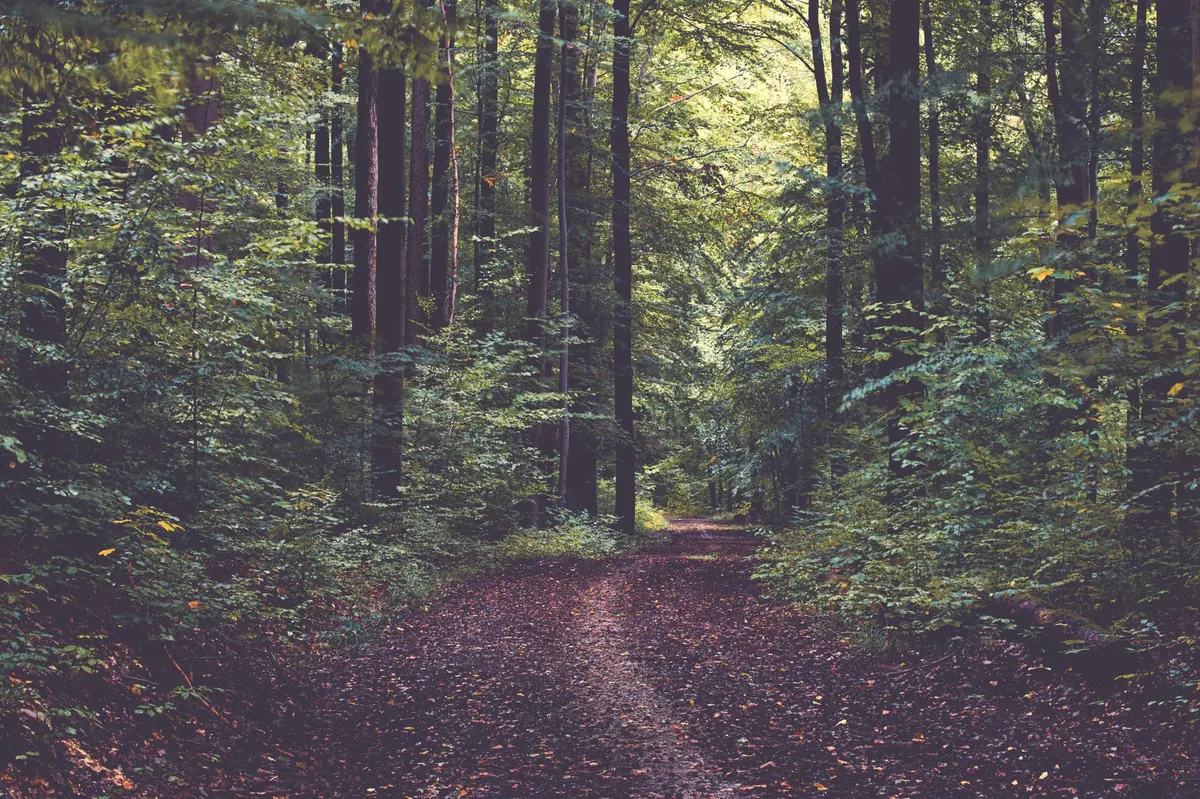
There is a particular smell in an oak wood after rain: wet bark, leaf litter, something faintly sweet you cannot quite name. Most of us walk straight through it on the way to somewhere else. Shinrin-yoku, usually translated as forest bathing, is the practice of not doing that. It needs no swimming costume, no cold water and no particular level of fitness. At heart it is a decision to slow down and let the wood set the pace.
What forest bathing actually means
Shinrin-yoku is a Japanese term that came into use in the 1980s to describe time spent among trees with your attention open — not as a route to be completed, but as something to be absorbed. The bathing is metaphorical. You are soaking in the atmosphere of the place rather than covering ground.
The practice is deliberately unambitious. A forest bathe might last twenty minutes and cover four hundred metres. Nothing is measured, nothing is achieved, and that is the point. You are not trying to reach a viewpoint or hit a step count. You are trying to notice where you are.
You do not need a forest either. A stand of mature trees at the end of your road, a churchyard with old yews, a riverside path lined with willows — anywhere with a few trees and a bit of quiet will do. Wilder places are lovely when you can reach them, but closeness matters more than scale.
What it is not
- Not a hike. If you finish out of breath and checking your watch, you have had a walk. That is fine, but it is a different thing.
- Not a workout. Gentle movement is enough; sitting still is often better.
- Not a rulebook. There is no correct number of minutes, no breathing pattern to master, no requirement to stay silent if you are with someone. Quiet conversation is allowed.
- Not foraging. Admiring fungi and leaves is part of the pleasure; picking and eating them is not. Leave the wood as you found it.
- Not a treatment. Many people find time in green space steadies them, but if you are living with anxiety, low mood or another health condition, treat this as something that sits alongside proper care rather than instead of it. Your GP is the person to ask.
A simple first walk, step by step
- Choose somewhere close. Aim for no more than twenty minutes' travel. A wood you can reach easily is a wood you will actually revisit.
- Go at an unhurried time. Early morning, or the last hour of daylight, tends to be quieter and better lit.
- Pocket the phone. Silent, not in your hand. Headphones off. If you use a map, check it, then put it away.
- Halve your pace. Most people walk far faster than they realise. Try covering half a mile in an hour, or less.
- Stop often. Stand still for two or three minutes at a time. Stillness is where the noticing happens; the trees do not mind.
- Find a sit spot. A bench, a dry bank, a fallen trunk. Ten minutes in one place will show you more than a mile of walking past it.
- Finish while it still feels good. Before you are cold, stiff or bored. Leaving early is what makes you come back.
Tuning in to your senses
The usual mistake is trying to do everything at once. Pick one sense for a stretch of the walk and let the others wait.
Sight
Look at what is close rather than at the view ahead. The veins on a single leaf, the way light comes through a canopy in patches, bark that is green with algae on one side only. Then look up, slowly, and notice how far the branches reach.
Sound
Stand still and listen in layers. Nearest sounds first — your own coat, your breathing, a twig shifting underfoot. Then further out: a wood pigeon's lazy rhythm, a stream you had not spotted, cars on a road half a mile away. Some people find that simply naming what they hear, silently, keeps the mind from wandering off.
Touch and smell
Run a hand over bark, moss, a smooth beech trunk. Crush a fallen leaf between your fingers and smell it. Notice the change in temperature when you step into shade, and the way the air smells different on a slope than in a hollow.
Where to go in Britain
You are spoiled for choice. The Woodland Trust, the National Trust and Forestry England all look after woods with public access, and most counties have a wildlife trust reserve or a community woodland within a short drive. Canal towpaths and old railway lines often have fine tree cover and level ground. If you want somewhere bigger, try the beech hangers of the Chilterns, the oakwoods of Wales, or the pinewoods of the Scottish Highlands.
Stay on public rights of way and permissive paths. Access rules differ across the UK, and a path that is open in one country may not be in another, so follow signs rather than assumptions. Long trousers and a check for ticks afterwards are sensible in summer, especially where there is bracken and long grass. If a bite worries you, ask a pharmacist or your GP rather than searching online.
Making it stick
The people who get the most from this are rarely the ones who plan a big trip. They are the ones who go out for twenty minutes on a Tuesday because the wood is five minutes away.
Try this: choose one wood, one sitting spot and one day of the week. Go there for a month, whatever the weather. Rain is not a reason to cancel — a hood and a waterproof will do more for your experience than a promising forecast. The same trees in February and in June are barely the same place, and you will only notice the change if you keep returning.
Keep it short, keep it regular, and leave the rest to the wood.
Photo: ArWeltAtty Attila / Pexels