Some days the mind is a busy kitchen: several pans on the go, nothing quite finished, and a timer you can't hear over the noise. You sit down meaning to be mindful, and within seconds you're drafting a reply to a message that hasn't arrived yet.
That is not evidence that you're bad at this. It's evidence that you're human and you've had a full week. The belief that you need a calm mind before you can practise is the wrong way round — the practice is often what lets the calm arrive, and it works perfectly well while your head is loud. Five minutes is enough to start.
Why five minutes is enough
Long sits carry a certain prestige, but when you're beginning, consistency matters more than duration. A five-minute practice you actually do on a Tuesday evening is worth more than a thirty-minute one you keep postponing until things settle down. They rarely settle down on their own.
There is one thing worth knowing before you begin. Noticing that your attention has wandered is not a failure. It is the moment the practice happens. You notice, you return, you lose it again, you return again. That loop — not the stillness — is the exercise. It's undramatic, and it changes how the rest of your day feels.
Start with the body, not the breath
When the mind is agitated, going straight to the breath can feel claustrophobic — as though you've been asked to hold still while something chases you. Begin instead where sensation is unmissable: contact.
- Feet. Press both soles into the floor. Feel heel, ball and toes, and the small weight shift as you breathe.
- Seat. Notice the weight of your body through the chair — the backs of your thighs, the base of your spine.
- Hands. Rest them palms down on your thighs or the table. Temperature, texture, the grain of the fabric or wood.
- Jaw and shoulders. Let your teeth part slightly, and allow your shoulders to drop a centimetre. They almost always can.
Spend a minute here. It gives a restless mind something concrete to hold, and it slows the pace enough that the breath becomes easier to meet afterwards.
A five-minute practice you can follow
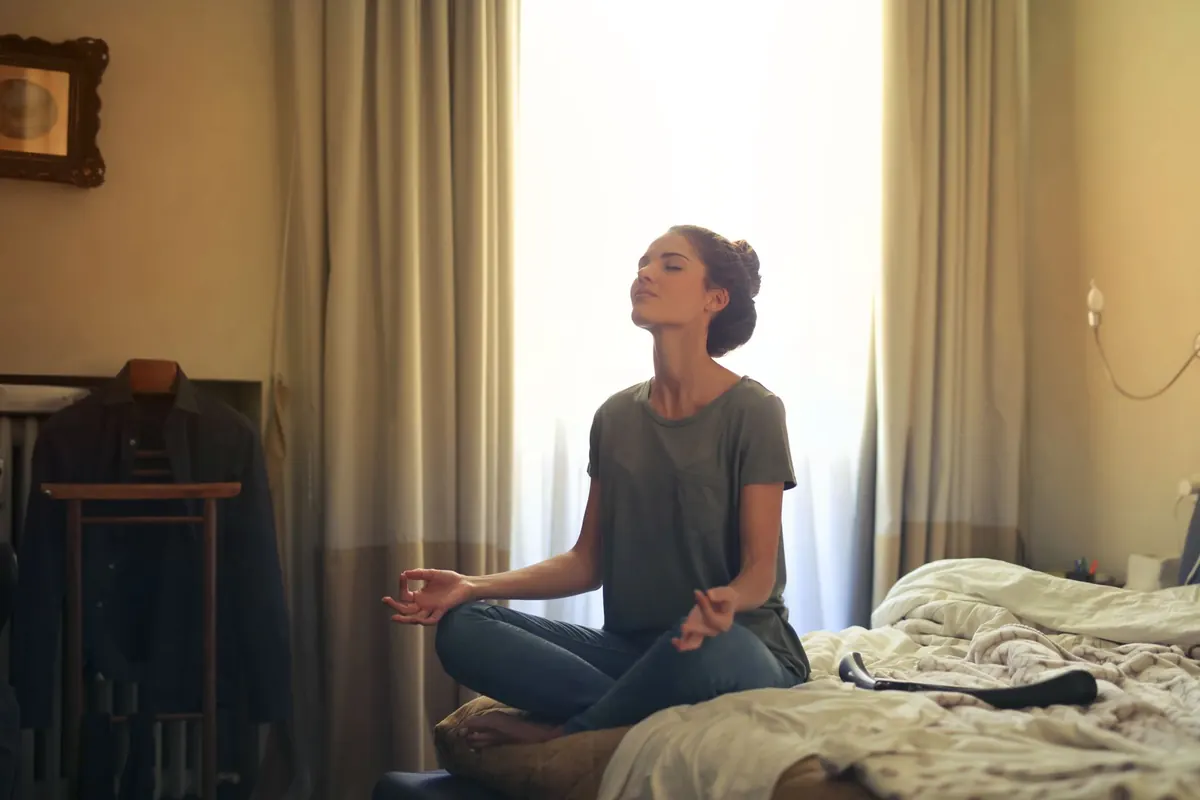
This is a shape rather than a script. Eyes closed, half-lidded or open with a soft gaze all work. Sitting on a bus counts. So does sitting in a parked car before you go into the house.
- Settle — about 30 seconds. Take the contact points from above: feet, seat, hands. Let the body take its own weight for a moment.
- Listen — about a minute. Let sounds arrive rather than reaching for them. A fridge hum, a car, your own breathing. You're not naming anything, just letting the ears be open.
- Breathe — about two minutes. Feel one breath at a time. Cool air at the nostrils, or the belly rising and falling. Don't deepen it. Just be present for the next one.
- Note — about 30 seconds. If the mind has run off — and it will — name it quietly: planning, worrying, rehearsing, remembering. Then return to a single breath.
- Close — about 30 seconds. Ask yourself what one thing you'd like to carry into the next hour. Open your eyes. That's the whole session.
Set a timer for five minutes if you like, but choose one that ends gently. Being startled back into the room undoes the point.
What to do when the mind won't settle
Give up on the quiet mind. You aren't trying to empty your head, and treating that as the goal guarantees you'll feel like you've failed. The shift is smaller and more realistic: a thought arrives, you notice it, and you choose not to follow it down the corridor. Then you do that again. Forty times in five minutes, if that's what today looks like.
Restlessness isn't an obstacle to the practice. It's the material you're working with.
Two adjustments help on the hard days. First, make the breath smaller, not bigger — a gentler, shorter breath is easier to stay with than a deep one. Second, shorten the session. Three minutes done beats five minutes abandoned, and you can always add a second three minutes later in the day.
Grounding through the senses
When thoughts are sticky and the breath feels slippery, the senses are more dependable. This sweep takes around ninety seconds and can be done standing at the kettle, queuing, or waiting for a page to load.
A quick senses sweep
- Name three sounds you can hear right now, including the quietest one.
- Feel two physical sensations — the floor under your feet, the air on the backs of your hands.
- Look at one thing in detail: not just "a mug" but the rim, the glaze, the shadow it casts.
- Optional, if you're somewhere sensible: one taste or smell.
Walking works too, and sometimes works better. Take ten slow steps and put your whole attention in each foot: the lift, the swing, the landing. Ten steps, then ten more if you need them. Nobody around you will notice you're doing anything at all.
Three habits that make it stick
Anchor it to something you already do
Rather than finding a new slot in the day, attach the practice to an existing one. After you switch the kettle on. Before you open your laptop. Once you're parked. The habit sticks to the routine, not to your willpower.
Lower the bar until it's almost silly
Two minutes with a timer is a legitimate practice. If you're waiting until you can manage twenty minutes in a quiet room, you'll be waiting a while, and the waiting itself becomes a small daily disappointment.
Expect the wobble
You will forget for a week. Start again without a speech about discipline. The only thing that matters is that the practice is small enough to restart cheaply.
A final note: short practices are not a substitute for support. If restlessness comes with persistent anxiety or low mood, or it's affecting your sleep, work or relationships, speak to your GP or another qualified professional. Mindfulness can sit alongside that help, but it isn't a replacement for it.
Small, repeated, unremarkable
The point of a five-minute practice isn't the five minutes. It's that you learn, over and over, that you can be in a restless mind without being run by it. That knowledge travels. It's there when the email lands badly, when the plan changes, when someone cuts you up on the ring road.
So pick one moment today. Feet on the floor, three sounds, one breath at a time. Five minutes, then get on with your evening. That's the whole method, and it's enough to begin with.
Photo: Andrea Piacquadio / Pexels